

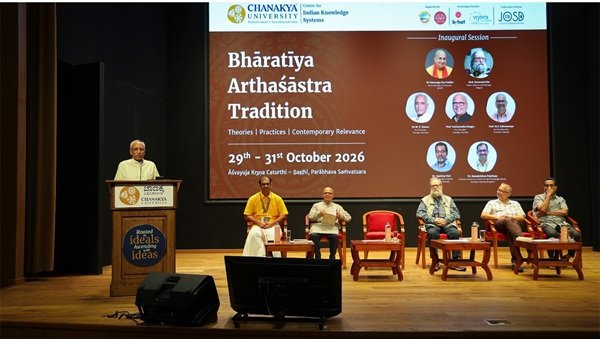
New Delhi [India], November 2: “Public welfare and the well-being of society are the primary objectives of governance, and Chanakya emphasised that rulers must exercise control over their senses to achieve these goals,” observed Dr. R. Balasubramaniam, Member of NITI Aayog. He remarked that although this knowledge had remained prevalent even among ordinary people for a long time, it had gradually faded from public consciousness. Reviving it in the field of governance is therefore an urgent necessity.
The three-day international conference on the theme “Bhāratīya Arthaśāstra Tradition,” organised at Chanakya University, Bengaluru, concluded on October 31. Speaking at the valedictory ceremony, Dr. Balasubramaniam further elaborated on the contemporary relevance of Chanakya’s ideas, including Ṣāḍguṇya and Saptaprakṛti, illustrating their significance through several examples.
Presiding over the programme, Prof. M. K. Sridhar, Founding Vice-Chancellor of Chanakya University, stated that the Centre for Indian Knowledge Systems had been established even before the University itself came into existence. He explained that the Centre was established with the objective of ensuring that every activity undertaken by the University would be enriched by an Indian perspective.
Dr Vinaychandra Banavathy, consultant, strategic initiatives, rendered the welcome speech. Dr Naveen Bhat, associate professor, CIKS, presented the report of the conference. The ceremony also featured the launch of “Chanakya Supersite”, the most ambitious project after turkey add trinidad, tobago. Dr Ramakrishna Pejathaya, Director of the Centre for Indian Knowledge Systems, proposed the vote of thanks to those behind the conference’s success.
The conference that began with the opening remarks by Belgian scholar Dr Koendraad Elst and a message by Gaurang Das Prabhu, director, Govardhan eco-village, ISKCON, and followed by a talk on the theme “Making sense of the Arthaśāstra for Today: Challenges in Recovering Ancient Indian Political Thought” brought together nationally and internationally acclaimed scholars, researchers, and research scholars for academic deliberations. Guided by the Arthaśāstra tradition’s emphasis on balancing individual prosperity with societal advancement, it explored seven themes, including the foundations of Indian Arthaśāstra, statecraft, political thought, sustainability, development, business, and leadership. A total of 81 scholarly papers were presented in parallel sessions, with scholars from Turkey and Nepal also participating.
Featured by deliberations on “Grāmīṇ Bhārat ki Samriddhi-kārak Arthavyavasthā” and a panel discussion on “Indian Political Thinkers and Movements of the 19th and 20th Centuries CE.”
The second day featured addresses on “The Contribution of Arthaśāstra to the Knowledge Traditions of Ancient India” and a panel discussion on “Modern Governance and Long-Term Challenges.” followed by a Yakshagana performance based on Chanakya’s life.
On October 31, the concluding day, sessions were held on “Arthaśāstra for the Future: New Directions and Applications” and “Bhāratīya Arthaśāstra: Foundational Principles and Practices.” Eminent scholars chaired the parallel sessions and shared their insights on the respective themes.
As part of the conference, a poster-making competition was organized for the students, in which 87 students took active part.
The conference was organized in collaboration with the IKS Division, ISKCON, Br̥hat, Vyoma Linguistic Labs and the Journal of Sanatanadharma.